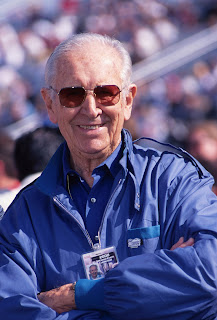
Wally Parks (1913 – 2007) The Specialty Equipment Market Association mourns the loss of one of the founders and greatest leaders of the industry. “The work and passion of Wally Parks launched a new form of motorsport and an industry. He serves as an inspiration to thousands of enthusiasts and business leaders who share his passion for hot rodding, innovation, and competition” said Chris Kersting, SEMA President and CEO. “The legacy Wally built will live on forever.” SEMA will provide information regarding arrangements and planned events as they become available. Included below is a news release from the NHRA.
NHRA FOUNDER WALLY PARKS, 1913-2007 Patriarch of Drag Racing Dies at Age 94 GLENDORA, Calif. (Sept. 28, 2007) – Wally Parks, the driving force behind the formation of NHRA, has died at the age of 94. It was Parks’ vision, goals and unconditional commitment to the need for speed and side-by-side racing in a safer, more controlled environment that created what is today the world's largest motorsports governing body. "Today is a sad day in the world of NHRA and the sport of drag racing," said Tom Compton, president of NHRA. "Words simply can't describe the immeasurable impact Wally has had on the sport he created and the millions of people's lives he touched along the way. The name Wally Parks is synonymous with drag racing, and his vision and direction will guide NHRA for years to come. Everyone in drag racing, and the industries formed to service the sport, will forever be indebted to Wally, his vision, his focus and his desire to create, build and grow NHRA." “Wally spent his lifetime doing what he loved,” said Dallas Gardner, chairman of the NHRA board of directors. “He marked the path and led the way for this incredible industry and the sport of drag racing. Wally was NHRA, and through his dream came a path to follow with lofty goals and ambition. He put the people in place and trusted in them. He has not abandoned us. He has left us with a road map that he knows will be followed.” Parks, who founded NHRA in 1951, received countless awards in the motorsports world and played a pivotal role in the establishment of an entire industry devoted to speed and automotive aftermarket parts and accessories that today is a multibillion-dollar business. Yet Parks never implied that he did it all himself. His pride and joy, and where he spent most of his time in recent years while still serving on NHRA's board of directors, was The Wally Parks NHRA Motorsports Museum presented by Automobile Club of Southern California at Fairplex in Pomona, Calif. Details regarding arrangements and planned events will be released at a later date. WALLY PARKS, 1913-2007 NHRA founder Chairman of NHRA Motorsports Museum The primary driving force behind the formation of the National Hot Rod Association, Wally Parks was the visionary whose early goals created what today is the world’s largest motorsports governing body. Parks, who founded NHRA in 1951, never implied that he did it all himself. Reflecting on the tremendous growth and success of NHRA, he noted how fortunate he was that so many dedicated people had shared his outlook that almost anything is possible if you believe in it strongly enough. One of the most dedicated was unquestionably his late wife, Barbara Parks, who was regarded as the most influential behind-the-scenes force in the growth of NHRA. Mrs. Parks succumbed to cancer in late January of 2006 after a long battle with the devastating illness. But without Parks’ vision and perseverance, much of what has happened may not have been achieved. Born in Oklahoma and living in Kansas until age 8, Parks and his family then moved to California, where his automotive interests surfaced. In his high school years, he became active in building stripped-down Model-T Fords and Chevy fours for use on the street and in early speed trials conducted on dry lakebeds in the Mojave Desert, north of Los Angeles. In 1937, Parks took part in the formation of the Southern California Timing Association (SCTA) – an organization focused on conducting land speed record events – serving as one of its officials until World War II began. In 1946, following military service in the South Pacific, Parks was elected president of the reorganized SCTA. In 1947, after 10 years of employment as a road test driver and process engineer for General Motors, Parks left GM to assume a new role as the SCTA’s general manager. It was his concept that produced America’s first Hot Rod Show, presented by the SCTA in 1948 at the Los Angeles Exposition Armory. In 1948, Parks helped co-publishers Bob Petersen and Bob Lindsay in the introduction of Hot Rod magazine, which became one of the world’s largest-circulation auto-enthusiast publications, and later was named its first editor. In 1949, Parks organized the campaign that led to the opening of Utah’s Bonneville Salt Flats for hot rod speed trials – a still-thriving annual activity. In 1951, utilizing Hot Rod as a conduit to nationwide readership, Parks formed the NHRA. In 1963, he resigned his position as editorial director for all of Petersen’s automotive magazines – Hot Rod, Motor Trend, Car Craft, Sports Car Graphic and Motor Life – to assume full-time administrative duties as president of NHRA. An early recipient of Car Craft magazine’s prestigious Ollie Award for his many contributions to motorsports, Parks was named Man of the Decade, 1962-1972 by Popular Hot Rodding magazine and was recognized as Man of the Year in 1973 by the Specialty Equipment Market Association (SEMA). The American Auto Racing Writers & Broadcasters Association (AARWBA) honored Parks in 1988 and again in 1994 for his pioneering efforts in motorsports. Parks received his highest honors in 1992 and 1993. He was drag racing’s first inductee into the International Motorsports Hall of Fame in 1992 in Talladega, Ala., and in 1993, he was inducted into the Motorsports Hall of Fame in Novi, Mich. In 1994, the tributes to Parks’ legacy continued to pile up. A large bronze statue of Parks was presented at NHRA’s Gainesville Raceway, which was eventually moved to its current location in front of the NHRA Motorsports Museum at Fairplex in Pomona, Calif. Later in 1994, Parks and wife Barbara were co-inductees into the Don Garlits International Drag Racing Hall of Fame in Ocala, Fla., for their pioneering efforts, which spearheaded NHRA’s success. Parks also was the first recipient of the Don Prudhomme Award, a trophy presented by NHRA to an individual who has made a profound impact on the growth and positive image of the NHRA POWERade Series. At the 2001 NHRA Awards Ceremony, Parks was presented the prestigious Blaine Johnson Award for his dedication, perseverance and nurturing commitment to the sport throughout the years. In 2002, Parks again was recognized for his many contributions to the sport of drag racing. He was presented with the inaugural Robert E. Petersen Lifetime Achievement Award at the fourth annual Hot Rod & Performance Trade Show in Indianapolis. The late Petersen, a renowned automotive publisher and creator of multiple automotive magazines, then presented Parks with the all-bronze sculpture which was created to honor the entrepreneurs who have contributed to the history, growth and well-being of the hot rod industry. In late 2003, Parks received another honor of distinction, as he was named the Dean Batchelor Lifetime Achievement Award winner by the Motor Press Guild in Los Angeles. Parks remained on NHRA’s board of directors and dedicated much of his time to his personal involvement with the cultivation and expansion of The Wally Parks NHRA Motorsports Museum at Fairplex in Pomona, home of the CARQUEST Auto Parts NHRA Winternationals and Automobile Club of Southern California NHRA Finals. Although much of the museum’s historical focus is on the evolution of NHRA and drag racing, it also features many other forms of motorsports that relate closely to the formative years of NHRA, including dry lakes, Bonneville, oval track racing, and allied performance industries. These are elements that appealed most to Wally Parks, a guy who had been there, done that, and enjoyed and appreciated it for decades. -30-

 Posts


